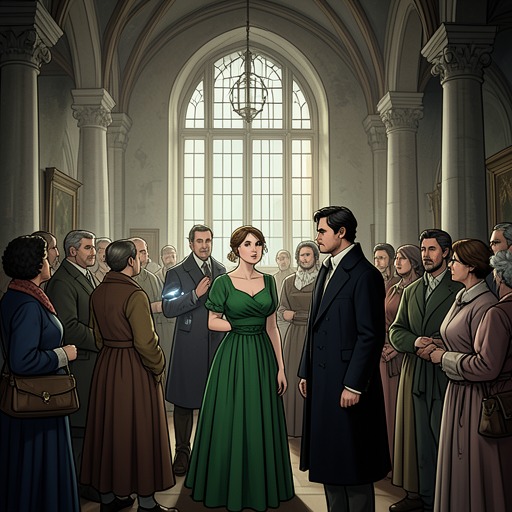
House of Lords
Just DesertsThe House of Lords is the clearest institutional symbol of formal aristocratic power in the novel. It is not presented primarily as a place of debate or ceremony, but as a political chamber whose members can vote on laws affecting trade, estates, and ordinary people. Through comparisons among the Darcy, Pentland, Maitland, and Bennet families, the narrative distinguishes the power of a title from the influence of wealth and the usefulness of personal connections.
Political Power and Trade
The House of Lords enters Elizabeth Bennet’s explanation of how society actually works. She identifies her uncle as an Earl who possesses both a title and a seat in the House of Lords, where he can vote on laws that may make or break ordinary people. The example is commercial rather than abstract: when the defeat of the Corsican tyrant reopens trade with continental Europe, Parliament will regulate that trade, and a lord with no ties to commerce may still help determine how a merchant such as Elizabeth’s uncle fares. In this account, legislation transforms distant aristocratic authority into a material force in the lives of people engaged in business.
Elizabeth therefore defines society through the combined operation of power, money, connections, and advancement. Her formulation separates political authority from economic competence. A person may understand trade without possessing a voice in lawmaking, while a lord may influence commercial prospects without participating in trade himself. The House of Lords gives this imbalance a constitutional form: inherited status becomes an instrument for shaping the conditions under which less privileged people work and prosper.
Titles, Marriage, and Family Networks
The chamber’s influence is also embedded in marriage strategy. Elizabeth describes the relatives surrounding Fitzwilliam Darcy as members of a hierarchy in which a Marquess, an Earl, and other titled men sit in the House of Lords and possess power. Their marriages connect private family decisions to public rank. Georgiana Darcy’s husband is a Marquess, Lily’s husband is a Viscount, and a cousin of Fitzwilliam Darcy’s father is an Earl; all three belong to the political world represented by the chamber.
The narrative contrasts these titled alliances with marriages shaped by wealth, affection, or chance. Lily married a second son who was initially only a newly qualified solicitor; she became a Viscountess only because the original heir died after ruining himself. Georgiana, by contrast, chose a conventional aristocratic marriage after observing the partnership of Elizabeth and Fitzwilliam Darcy. Catherine Bennet married Nicholas Charrington, heir to a prosperous brewing company, rather than entering the titled world. These outcomes show that the House of Lords is not merely an institution separate from domestic life. Its social authority structures the field of desirable marriages, while family members can still choose different forms of happiness within or beyond that hierarchy.
Wealth Without a Seat
The House of Lords provides a measure against which the Darcy family’s own position is judged. Elizabeth explains that her family is wealthy and possesses influence and connections, but does not possess power in the same institutional sense. The distinction becomes visible when titled relatives oppose the Reform Act: Georgiana Darcy’s husband and the Earl in the family supported opposition to the measure, while Fitzwilliam Darcy and Elizabeth supported it. Because the titled men held political authority, disagreement could not be resolved simply by argument. Their position in the House of Lords gave their views a weight that wealth alone could not match.
This contrast complicates any simple division between aristocrats and outsiders. Fitzwilliam Darcy’s family belongs to the political elite, yet Elizabeth and Fitzwilliam Darcy do not automatically share every political judgment held by titled relations. The institution thus exposes both privilege and internal disagreement. Membership supplies power, but it does not guarantee wisdom, moral agreement, or familial closeness.
Ecclesiastical and Legal Authority
The House of Lords also expands beyond hereditary secular titles through the career of Oliver Jackson. Mary Bennet marries him when he is a devout clergyman well versed in Canon Law; he rises from parish priest to Bishop of Oxford and takes a seat in the House of Lords. Elizabeth realizes that she had omitted him when listing relatives who possess power. His advancement demonstrates that the chamber can include ecclesiastical authority as well as hereditary aristocracy.
Oliver’s position also reinforces the novel’s interest in competing systems of rule. Elizabeth invokes Canon Law when defending her refusal of William Collins, arguing that a bride cannot be forced into marriage and that the command for parents not to provoke their children matters alongside the command that children obey. Her reasoning places family pressure, church law, and individual consent into tension. Oliver’s later position in the House of Lords gives the institutional church a political extension, linking the legal and religious language used within the family to the national structure of authority.
Narrative Significance
The House of Lords makes visible the machinery behind the social world that Elizabeth is learning to read. Longbourn’s inheritance depends on legal documents and the tracing of male succession, while the fates of marriages depend on titles, estates, dowries, and connections. The chamber belongs to the same larger order: an arrangement in which status is converted into legal and political power and then passed through families.
Yet the novel does not treat membership as the only form of agency. Elizabeth acquires knowledge of business, questions inherited assumptions, and evaluates the difference between influence and power. The women around her make choices within severe constraints: Georgiana embraces a traditional aristocratic role, Catherine chooses a man in trade, Mary joins the church, and Elizabeth resists being treated as property in the struggle over Longbourn. The House of Lords remains powerful, but its authority becomes one element in a wider contest over who may decide the terms of family, property, marriage, and social life.